

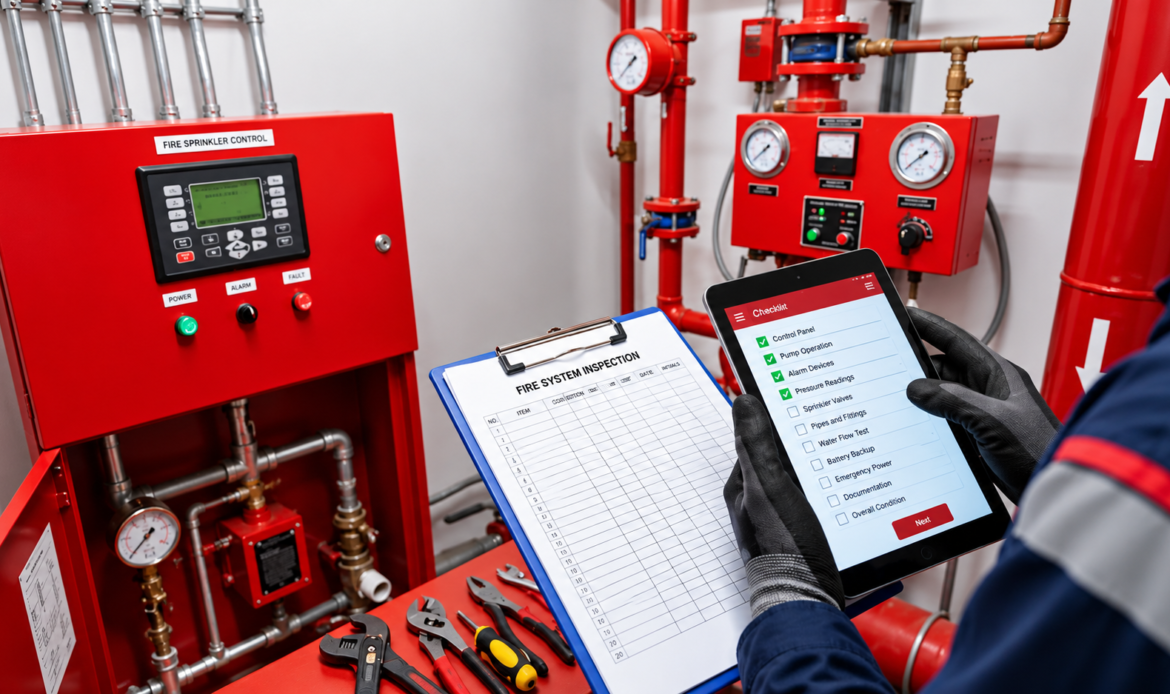
Fire protection services Melbourne property managers arrange cover two essential areas: maintaining building safety systems and preparing occupants for emergencies. Both require careful coordination, particularly in commercial properties with multiple tenants, shared facilities and different safety responsibilities.
In Victoria, building owners must maintain applicable essential safety measures, while employers and occupiers have additional workplace safety responsibilities. Property managers often coordinate inspections, contractors, maintenance records and emergency preparedness activities on behalf of building owners.
A missed inspection, unresolved equipment fault or outdated evacuation diagram can create unnecessary risks. Property managers need to know which systems require attention, who is responsible for each activity and how to keep safety arrangements up to date.
This guide explains commercial fire protection services in Melbourne, Victorian essential safety measures, equipment maintenance, evacuation planning, workplace training and how to choose suitable service providers.
What Do Commercial Fire Protection Services Include?
Commercial fire protection covers the equipment, building features, procedures and training used to detect fires, support emergency responses and help occupants evacuate safely.
The services required depend on a building’s classification, occupancy, layout, installed systems and applicable regulations.
Common services include:
- Fire extinguisher servicing: Inspecting and maintaining portable extinguishers to help ensure they remain suitable and operational.
- Fire hydrant and hose reel testing: Checking installed firefighting water systems against applicable maintenance requirements.
- Fire detection and alarm servicing: Testing systems that detect fire conditions and warn building occupants.
- Fire sprinkler maintenance: Inspecting and maintaining automatic sprinkler systems where installed.
- Fire door inspections: Checking doors, seals, hardware and related components for defects affecting fire and smoke separation.
- Emergency lighting and exit signage checks: Maintaining systems that help occupants identify and use escape routes.
- Evacuation diagram preparation: Creating accurate diagrams that communicate escape routes and relevant emergency information.
- Fire safety training: Preparing employees, fire wardens and designated personnel to respond appropriately during emergencies.
Not every fire protection company provides all these services.
Technical equipment maintenance, evacuation planning and workplace training may require different qualifications and expertise. Property managers should identify the services their building needs before selecting providers.
For example, a company specialising in evacuation diagrams and training should not automatically be assumed to maintain sprinklers, hydrants or fire detection systems.
Confirming each provider’s scope of work helps avoid gaps in maintenance and emergency preparedness.
Understanding Fire Safety Responsibilities in Victoria
Commercial fire safety in Melbourne involves both building maintenance and workplace emergency preparedness.
These responsibilities may sit with different parties, so property managers need a clear understanding of the obligations affecting the buildings they manage.
In Victoria, the Building Act 1993 and Building Regulations 2018 establish requirements relating to essential safety measures in relevant buildings.
Essential safety measures (ESMs) are building features and systems designed to protect occupants during emergencies.
The Building and Plumbing Commission’s guidance on essential safety measures explains building owners’ responsibilities for maintaining applicable measures.
Depending on the property, essential safety measures may include fire detection and alarm systems, extinguishers, hydrants, sprinklers, fire doors, emergency lighting and safe paths of travel to exits.
Building Owners and Property Managers
Building owners are responsible for maintaining applicable essential safety measures.
Property managers commonly coordinate the activities needed to support these obligations, including arranging contractors, managing maintenance records and following up on defects.
Key tasks include:
- Reviewing occupancy permits, maintenance determinations and relevant building documentation.
- Identifying the essential safety measures applicable to the property.
- Scheduling required inspections, testing and maintenance.
- Engaging appropriately qualified service providers.
- Recording defects and arranging corrective action.
- Maintaining inspection, servicing and repair records.
- Supporting preparation of the annual essential safety measures report.
An authorised agent may prepare the annual report, but appointing an agent does not remove the building owner’s underlying maintenance responsibilities.
For property managers, the priority is maintaining a reliable record of what needs servicing, when work is due, who is responsible and which issues remain unresolved.
Building Occupiers and Employers
Fire safety responsibilities extend beyond building owners.
Building occupiers have obligations relating to keeping exits and paths of travel accessible and unobstructed.
Employers and people managing workplaces may also have responsibilities under Victorian occupational health and safety legislation. These include maintaining safe working environments and providing appropriate emergency procedures and employee instruction.
In a multi-tenanted commercial property, the property manager may coordinate shared building systems while individual employers manage workplace-specific emergency instructions and staff training.
These arrangements need to work together.
For example, employees working in separate tenancies may use shared exits and assembly areas during an evacuation. Clear procedures and communication between tenants, designated emergency personnel and building management help reduce confusion.
Documenting responsibilities makes it easier to identify who must arrange maintenance, provide training and respond when an issue arises.
Essential Fire Protection Equipment and Maintenance
Commercial buildings can contain several fire protection systems, each serving a different purpose.
Property managers do not need to perform technical inspections themselves. They do need to understand which systems are installed, how they are maintained and what happens when a contractor identifies a defect.
The following table summarises common fire safety systems and the information property managers should monitor.
| Fire Safety System | Main Purpose | What Property Managers Should Monitor |
| Fire extinguishers | Support initial firefighting where safe and appropriate | Suitability, accessibility, condition and servicing records |
| Fire hydrants | Provide water supply access for firefighting operations | System performance, access and testing |
| Fire hose reels | Provide a firefighting water supply for suitable users and situations | Condition, accessibility and maintenance |
| Fire detection and alarms | Detect fire conditions and warn occupants | Testing, faults, maintenance and warning coverage |
| Fire sprinklers | Automatically discharge water when activated by heat | System condition, maintenance and outstanding defects |
| Fire doors | Help maintain fire and smoke separation | Door operation, seals, hardware and unauthorised alterations |
| Emergency lighting and exit signs | Help occupants identify and use escape routes | Operation, visibility and maintenance records |
Understanding Inspection and Maintenance Requirements
Fire protection equipment does not follow one universal servicing schedule.
Maintenance requirements depend on the equipment, building documentation, applicable standards and relevant regulatory obligations.
AS 1851:2012, Routine service of fire protection systems and equipment, is a relevant Australian Standard referenced by WorkSafe Victoria.
However, property managers should establish the specific maintenance requirements applying to their building rather than assume every system follows the same inspection interval.
A building-specific maintenance schedule should record:
- Each applicable essential safety measure.
- The required inspection, testing or maintenance activity.
- The relevant servicing interval.
- The contractor responsible for the work.
- The date of the most recent service.
- The next scheduled inspection.
- Outstanding defects and corrective actions.
A central maintenance register keeps this information organised, particularly when several contractors work across the same property.
It also supports follow-up after inspections.
If a contractor identifies a defective fire door, recording the fault is only the first step. The property manager must also coordinate appropriate corrective action and retain the relevant documentation.
This process helps prevent reported defects from remaining unresolved between inspections or being overlooked during annual reporting.
Why Evacuation Diagrams and Emergency Planning Matter
Fire protection equipment helps detect and manage fire-related risks. Emergency planning addresses another important question: what should occupants do when an emergency occurs?
A building may have maintained alarms, sprinklers and other safety systems but still need accurate evacuation diagrams, clear emergency procedures and employees who understand their responsibilities.
These arrangements are especially important in properties with multiple tenancies, shared exits or changing internal layouts.
Evacuation Diagrams
Evacuation diagrams provide visual information about a building’s emergency evacuation arrangements.
Depending on the facility and applicable requirements, diagrams may show:
- Evacuation routes and exits.
- Relevant firefighting equipment.
- Emergency assembly information.
- Other features needed to understand the facility’s emergency arrangements.
Diagrams should accurately represent the information they are intended to communicate.
Their position and orientation should also help occupants understand where they are and which evacuation routes apply.
Property managers should review existing diagrams following building works, tenancy changes or alterations to internal layouts.
For example, dividing an office floor into separate tenancies may change access to corridors and exits. A diagram showing the previous layout could confuse occupants during an evacuation.
Updating the information helps ensure the diagrams remain relevant to the building’s current configuration.
Australian Fire Protection provides evacuation diagram services for organisations reviewing their emergency documentation.
Emergency Management Plans
An emergency management plan explains how an organisation prepares for and responds to foreseeable emergencies.
For commercial workplaces, the plan may address:
- Emergency reporting and communication.
- Evacuation procedures and responsibilities.
- Fire wardens and emergency control personnel.
- Assistance for people who require support during evacuation.
- Coordination with emergency services.
- Staff instruction and emergency exercises.
- Procedures for reviewing and updating the plan.
A useful emergency plan reflects how the facility is occupied and operated.
In multi-tenanted buildings, this includes considering how individual workplace procedures interact with shared exits, assembly arrangements and designated emergency personnel.
WorkSafe Victoria recommends that offices consider evacuation procedures, trained wardens, coordination with emergency services and regular emergency exercises.
Australian Standard AS 3745:2010, Planning for emergencies in facilities, provides a framework for developing and maintaining emergency preparedness arrangements.
Organisations reviewing their procedures can explore emergency planning under AS 3745 for further information.
Emergency arrangements should also be reviewed when changes to occupancy, layouts or workplace operations affect the way people would respond during an incident.
The Role of Fire Safety Training in Commercial Buildings
An emergency plan is only effective when the people expected to follow it understand their responsibilities.
Fire safety training helps employees recognise emergency warnings, follow evacuation procedures and carry out assigned duties.
Training requirements differ between workplaces and roles. General employees, fire wardens and people authorised to use firefighting equipment may need different levels of instruction.
General Employee Training
Employees should understand the emergency arrangements relevant to their workplace.
This includes knowing:
- What workplace alarm signals mean.
- Which evacuation routes and exits to use.
- Where to assemble after evacuating.
- How to report an emergency.
- Who to contact for assistance.
- How to follow instructions from designated emergency personnel.
Employees working in multi-tenanted buildings may also need to understand how their workplace’s procedures connect with the building’s wider evacuation arrangements.
Clear instruction helps reduce uncertainty when an alarm sounds.
Fire Warden and Emergency Control Training
Fire wardens and other designated emergency personnel have responsibilities under workplace emergency arrangements.
Their training may cover evacuation coordination, communication, assigned duties and procedures for supporting occupants.
Training should reflect the facility’s emergency management plan and the responsibilities allocated to each participant.
For buildings with several tenants, property managers should establish how designated personnel communicate and how shared evacuation arrangements are coordinated.
This is particularly important where employees from different workplaces use common exits and assembly areas.
Fire Extinguisher Training
Employees authorised to use portable fire extinguishers may need instruction in fire types, extinguisher selection, safe operating methods and equipment limitations.
Training should also explain when attempting initial firefighting would be unsafe.
Protecting people and following emergency procedures must remain the priority. Initial firefighting should only be attempted when conditions are safe and the person has appropriate training.
Australian Fire Protection offers fire safety training courses, including training associated with emergency response and fire wardens.
For Melbourne workplaces, property managers should confirm which training options are suitable and what delivery and scheduling arrangements are available.
How to Choose Fire Protection Service Providers in Melbourne
Choosing a fire protection provider involves more than comparing quotations.
Property managers need to know whether a provider can perform the required work, has the appropriate qualifications and supplies reliable documentation.
The following checks can help when selecting services for a Melbourne commercial property.
1. Match the Provider to the Required Services
Start by identifying the building’s installed fire safety systems and emergency preparedness requirements.
Separate technical equipment maintenance from evacuation planning, documentation and workplace training.
A company offering fire safety training should not automatically be assumed to maintain fire hydrants, sprinklers or alarm systems.
Confirm which services the provider delivers directly and whether specialist contractors are needed.
This helps ensure the work is assigned to a provider with the relevant capabilities.
2. Check Relevant Qualifications and Competencies
Ask prospective providers about the qualifications, registrations, licences and competencies relevant to the work.
Requirements may differ between technical fire protection maintenance, evacuation documentation and workplace training.
The priority is confirming that the people completing the work have the competencies required for that activity.
3. Request a Clear Written Scope
A written quotation should explain what the provider will deliver and identify exclusions.
For inspection and maintenance work, clarify:
- Which systems and components are covered.
- What inspections or tests are included.
- How defects will be reported.
- Whether repairs require separate approval.
- What records will be supplied.
For evacuation planning and training, confirm the expected documents, required site information, consultation arrangements and course details.
A clear scope makes quotations easier to compare and reduces misunderstandings.
4. Check Reporting and Follow-Up Arrangements
Completed work should be supported by appropriate records.
For technical maintenance, ask how the provider documents inspections, defects, corrective actions and unresolved issues.
For emergency planning and training, establish which diagrams, plans or participation records will be supplied.
Property managers should also understand how outstanding issues will be communicated and who is responsible for arranging further action.
Accurate documentation is especially useful when reviewing a property’s maintenance history or preparing annual essential safety measures reports.
5. Confirm Melbourne Service Availability
Before engaging a provider, confirm whether the proposed services are available for the Melbourne property.
Discuss site attendance, travel arrangements, scheduling and follow-up requirements where relevant.
For properties with restricted access hours or multiple tenants, coordinating these arrangements early can help reduce disruption.
If a service can be delivered remotely, establish what building information is required and how the completed work will be checked for accuracy.
Australian Fire Protection’s suitability should be assessed against the specific service required and its confirmed availability for the Melbourne location.
Practical Steps for Managing Commercial Fire Safety
Property managers often coordinate several fire safety activities at once. A consistent process helps track obligations, communicate with contractors and identify unfinished work.
These seven steps provide a practical framework.
Step 1: Review Building Documentation
Examine the occupancy permit, maintenance determination and associated records to identify the essential safety measures applicable to the property.
Confirm that the available documentation reflects the building and its approved requirements.
Step 2: Create a Maintenance Schedule
Record the required inspections, testing and servicing activities for each applicable measure.
Include the relevant maintenance intervals, responsible contractors and next scheduled service dates.
Step 3: Clarify Responsibilities
Establish who arranges inspections, authorises corrective work, maintains records and communicates with building occupants.
Document arrangements affecting shared areas and individual tenancies.
Step 4: Coordinate Service Providers
Arrange work around building access requirements and operating hours.
Confirm contractors can access the systems and areas they need to inspect.
Step 5: Monitor Defects and Corrective Action
Record identified faults, required repairs and outstanding work.
Follow up with the responsible parties and retain documentation of completed corrective action.
Where defects affect safety, ensure appropriate action is considered and arranged.
Step 6: Review Emergency Preparedness
Check that evacuation diagrams, emergency procedures and staff instructions reflect the current building layout, occupancy and use.
Identify whether emergency arrangements or training need updating.
Step 7: Maintain Records and Complete Reporting
Retain relevant inspection, servicing and repair documentation.
Coordinate annual essential safety measures reporting where required and ensure outstanding issues receive appropriate attention.
For managers responsible for several properties, a centralised maintenance register can help organise inspection dates, contractor records, defects and reporting responsibilities.
The aim is to maintain a clear picture of completed work, outstanding requirements and the next action needed to keep fire safety arrangements on track.
Frequently Asked Questions
Who Is Responsible for Fire Protection in a Commercial Building?
Building owners are responsible for maintaining applicable essential safety measures under Victorian building legislation.
Occupiers and employers may have additional responsibilities relating to safe access, workplace conditions and emergency arrangements.
Property managers often coordinate inspections, contractors and documentation on an owner’s behalf.
In multi-tenanted properties, these responsibilities should be clearly documented.
How Often Should Fire Protection Equipment Be Tested?
Inspection and maintenance intervals depend on the equipment, approved building documentation and applicable regulatory requirements.
Different systems may have different servicing schedules.
A suitably qualified provider should confirm the requirements for each installed system using the relevant documentation and obligations.
Are Annual Essential Safety Measures Reports Required in Victoria?
Owners of applicable buildings in Victoria must prepare annual essential safety measures reports.
These reports concern the maintenance of relevant safety measures and are supported by inspection and maintenance records.
The requirements for an individual property should be established from its building documentation and applicable legislation.
Do Commercial Buildings Need Evacuation Diagrams?
Evacuation diagrams are a recognised part of emergency preparedness under AS 3745.
Whether diagrams are required, and the format they must follow, depends on the building, its use and applicable emergency planning obligations.
Existing diagrams should also be reviewed when changes to the building affect evacuation information.
Can One Provider Manage All Fire Safety Requirements?
Some providers offer several fire protection services, while others specialise in equipment maintenance, emergency planning or workplace training.
A business providing evacuation diagrams and training may not perform technical maintenance on fire alarms, hydrants or sprinklers.
Confirm each provider’s service scope, qualifications and availability before engaging them.
Supporting Emergency Preparedness in Melbourne Workplaces
Managing commercial fire safety involves more than keeping equipment inspection records.
Property managers need to understand their building’s applicable essential safety measures, coordinate contractors, monitor outstanding defects and help ensure emergency procedures reflect how the property is used.
Clear responsibilities are particularly important in multi-tenanted buildings, where owners, tenants, employers and service providers may be responsible for different activities.
Regularly reviewing maintenance records, evacuation information and workplace training helps identify arrangements that need attention.
Australian Fire Protection provides services relating to fire safety training, evacuation diagrams and emergency preparedness. These services may support organisations reviewing their evacuation procedures and preparing employees for workplace emergencies.
If your commercial property has undergone layout changes, tenancy updates or a review of its emergency arrangements, it may be time to reassess the information and training available to occupants.
Explore Australian Fire Protection’s courses and services to understand the available options.
Contact Australian Fire Protection to discuss your fire safety training, evacuation diagram or emergency planning requirements and confirm which services are available for your Melbourne property.